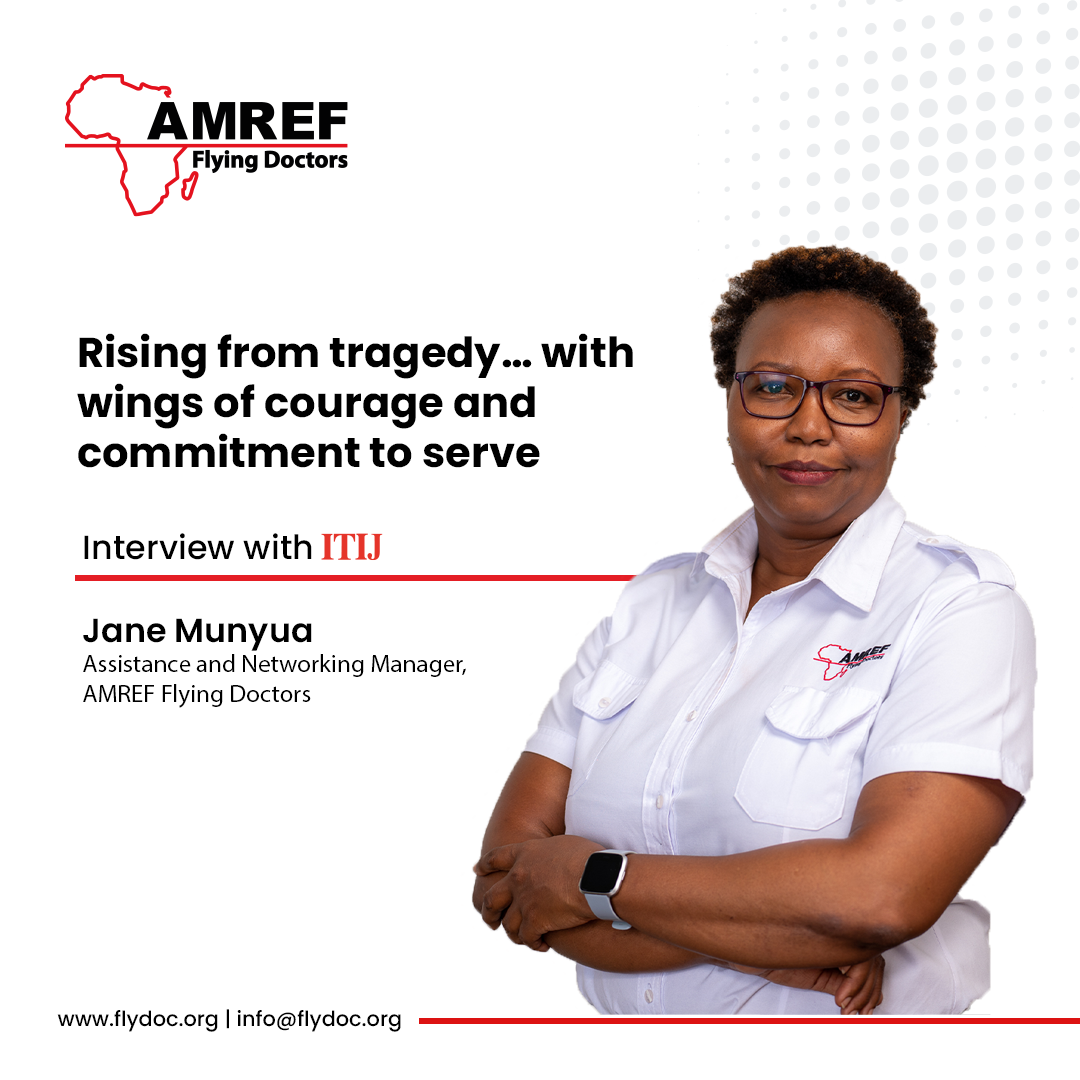
Jane Munyua, Assistance & Networking Manager at AMREF Flying Doctors, recounts a urgent repatriation for an elderly patient
A day that changed everything The 7 August 2025 will remain forever etched in our memories at AMREF Flying Doctors (AFD). On that day, tragedy struck and left a void so immense, so devastating, that it is still difficult to describe without thinking it is just a bad dream.
What should have been a moment of celebration marking our 68th anniversary in existence, turned instead into one of grief. Families and colleagues were left shattered, robbed of precious lives and of a valued aircraft that had faithfully served our operations.
Ever since, we have gone through the motions of daily work, purposing to return to normal. But can we ever truly be the same after that day? Perhaps not. Yet, amid pain, our teams have demonstrated remarkable resilience.
One week later after the tragedy happened, our Wings of Courage took off from Nairobi to Belgium. That flight carried more than a patient. It carried a message – that even in loss, AFD’s mission to save lives would not falter. Since then, we have completed several other medical evacuation missions and repatriations, each one proof of our determination to keep flying.
The call for help
On 23 August 2025, we received an urgent request from one of our international assistance partners. An elderly woman, on holiday with her family in eastern Kenya, had collapsed and was admitted to hospital. She appeared to have suffered a major stroke, complicated by underlying medical conditions including hypertension and diabetes.
As both an air ambulance provider and a trusted assistance partner to more than 100 international assistance companies and insurers, AFD is often called upon not only to transport patients but also to advise on the capabilities of local healthcare facilities within Africa. In this case, the partner relied on our local knowledge of the hospital in Kenya where the patient was admitted and our ability to guide them on the best course of action for their client.
In stroke care, time is brain – every minute saved meant giving the patient a chance at recovery
Navigating the local system
The patient’s journey through the healthcare system was already challenging. From her hotel room, she was first taken by ambulance to a Level 4 hospital. Shortly afterwards, she was transferred again, more than an hour’s drive away, to another facility for an urgent MRI. Once the scan was completed, she was taken back to the original hospital – a round trip of more than four hours including time in the hospital, that placed her under unnecessary strain.
We eventually received her initial medical report on 24 August. It recommended yet another transfer back to the hospital where the MRI was initially performed. We knew this repeated back and forth would not help the patient’s condition. Stroke patients require immediate, specialist care.
Guided by our Medical Director, we advised the assistance company to transfer the patient instead to Aga Khan University Hospital in Nairobi, a recognised Stroke Management Centre.
In stroke care, time is brain – every minute saved meant giving the patient a chance at recovery. This principle guided our decision. She had suffered a severe stroke, and time was critical.
Taking to the skies
We provided an air ambulance quotation, which was accepted. The flight was activated and took off on the evening of 24 August with a crew comprising two pilots, a doctor and an ICU nurse.
Our control room nurse stayed in constant communication with the discharging hospital to ensure that a ground ambulance would meet our team on arrival. This is our standard practice; a proper bed-to-bed handover is always done for critically ill patients.
When our team reached the patient, her condition had deteriorated further.
She now required ventilatory support, close monitoring and stabilisation of her blood pressure as well as other vital functions.
After carefully preparing her for transfer, the team transported her back to the airport in the hospital ambulance. Our aircraft departed and landed in Nairobi at 20:00h EAT, and the patient was transferred to Aga Khan University Hospital. She was admitted directly to the ICU under the Department of Neurology, avoiding any delays in the emergency department. Just one week after tragedy, our Wings of Courage took flight, proving that our mission to save lives would not falter.
Beyond transport: assistance in action
AMREF Flying Doctors’ responsibility in this case did not end with the medevac flight to Nairobi. We were also requested to provide medical assistance services, including a guarantee of payment for the patient’s admission and close follow-up of her medical progress through medical reports.
By admitting her under the Department of Neurology, we ensured we received timely updates through the hospital’s liaison doctor, which we in turn relayed promptly to our partner in Europe. For AFD, it is never only about the transport itself; It is about complete continuity of care. Beyond transport, our role is to reassure the assistance partners that their patients are cared for every step of the journey.
Just one week after tragedy, our Wings of Courage took flight, proving that our mission to save lives would not falter
Preparing for repatriation
In the days that followed, the patient’s condition stabilised to a point that she could be repatriated by air. It soon became clear, however, that she would require longterm rehabilitation in her home country. The assistance partner began securing admission in an ICU bed in Europe.
Once the bed was confirmed and the date of travel agreed on, our medical crew carried out a pre-flight bedside assessment on 1 September. This is a vital part of planning, allowing our team to evaluate the patient’s current condition, anticipate in-flight needs and meet with the patient’s family to explain the plan of care during the flight. It also ensures alignment with the treatment being received in the hospital.
On 2 September, our medical team picked up the patient from Aga Khan University Hospital and transferred her to Wilson Airport. Our Citation Sovereign C680, in full air ambulance mode, was ready. After carefully loading the patient into the aircraft and stabilising her, the medical team gave the thumbs up for take-off. With only one stop in Egypt, the patient was flown safely to Europe, where she was handed over directly to the ICU team of the admitting hospital in a critical but stable condition. Her family, who had been waiting anxiously, were finally able to welcome her home.
Commitment despite adversity
This repatriation case reflects who we are. AMREF Flying Doctors is not only an air ambulance provider, but also an assistance partner, ensuring patients are supported from the first hospital admission to the final handover whether at hospital or at home. It also reflects our resilience and dedication to support our partners and the patients they entrust in our care. It is about co-operating and collaborating with other medical providers for the seamless treatment and eventual repatriation of patients.
The events of 7 August 2025 left the AMREF fraternity scarred. But through every evacuation since, we have continued to raise the flag of professionalism and service. Each mission is a reaffirmation of our calling: to serve and save lives.
The Wings of Courage are more than just an aircraft. They symbolise continuity, hope, and the strength of our commitment to the patients, clients and partners who rely on AMREF Flying Doctors in their most critical moments.
Beyond transport, our role is to reassure the assistance partners that their patients are cared for every step of the journey
First Published: ITIJ Magazine _ Assistance & Repatriation Review | October 2025
Author: Jane Munyua – Assistance & Networking Manager at AMREF Flying Doctors
Editor: Jane W. Muthoni